


Hoist Ring - Swivel, Heavy-Duty 360 Rotation | ISO Certified
What’s Changing (and What Still Matters) in the Hoist ring Market
I’ve spent enough time on rigging floors to know this: a bad lift is usually a preventable one. And lately, the most interesting conversations I hear aren’t about cranes—they’re about hardware. The humble Hoist ring has quietly evolved: higher grades of alloy steel, 360° swivel designs, RFID traceability, and stricter batch testing. From a factory in South of Xi Zhaozhuang Village, Lin Luoguan Town, Yongnian District, Handan City, Hebei Province (West side of Jianshe Road), I recently reviewed a line that reflects exactly that shift—practical innovation, not hype.
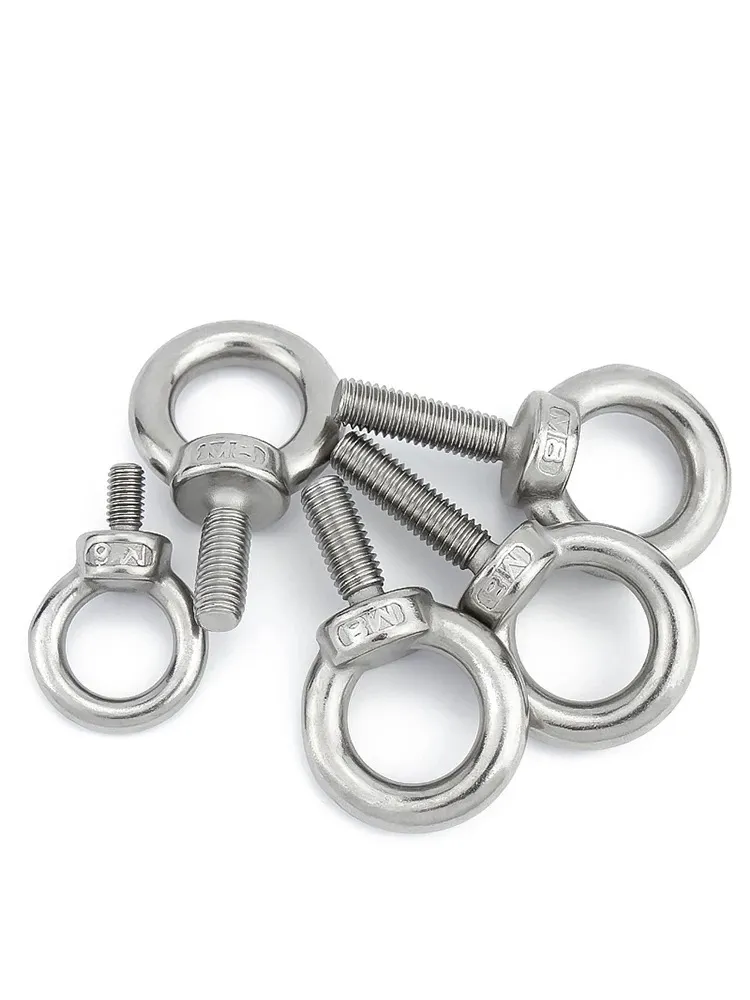
Specs at a Glance (real-world values may vary)
Sizes available: M6, M8, M10, M12, M14, M16, M18, M20, M22. Common material is quenched-and-tempered alloy steel (e.g., 42CrMo), Grade 10+ strength, with black oxide or zinc plating. Typical temp window: −40°C to +200°C.
| Thread | Approx. WLL (t) | Proof Load | Install Torque (dry) |
|---|---|---|---|
| M6 | ≈0.35 | ≥2.5× WLL | ≈10 N·m |
| M8 | ≈0.5 | ≥2.5× WLL | ≈25 N·m |
| M10 | ≈0.8 | ≥2.5× WLL | ≈50 N·m |
| M12 | ≈1.2 | ≥2.5× WLL | ≈80 N·m |
| M14 | ≈1.5 | ≥2.5× WLL | ≈110 N·m |
| M16 | ≈2.0 | ≥2.5× WLL | ≈200 N·m |
| M18 | ≈2.5 | ≥2.5× WLL | ≈270 N·m |
| M20 | ≈3.2 | ≥2.5× WLL | ≈400 N·m |
| M22 | ≈4.0 | ≥2.5× WLL | ≈540 N·m |
Safety factor typically 4:1 or 5:1 depending on the model and standard. Always verify the load chart for your specific Hoist ring and lift geometry (angle, orientation, thread engagement).
How They’re Made (and Tested)
-
- Materials: alloy steel (42CrMo or similar), forged or precision-machined yokes and rings.
- Heat treatment: quench & temper for high toughness; hardness controlled batch-wise.
- Surface: black oxide or zinc; optional phosphate for paint adhesion.
- Methods: CNC threading to ISO metric tolerances; swivel assemblies with needle or thrust bearings (on rotating models).
- Testing: proof load ≥2.5× WLL per EN 1677; sample break tests targeting ≥4× WLL; 100% visual, thread gauges, MPI or UT on critical lots; salt-spray checks (48–96 h) for plated parts.
- Certifications: factory ISO 9001; product marking to ASME B30.26 where applicable; CE documentation for integration under EU Machinery Directive (when part of a system).
- Service life: often thousands of cycles if used within WLL, correctly torqued, and inspected; retire on deformation, corrosion pitting, or NDT indications.
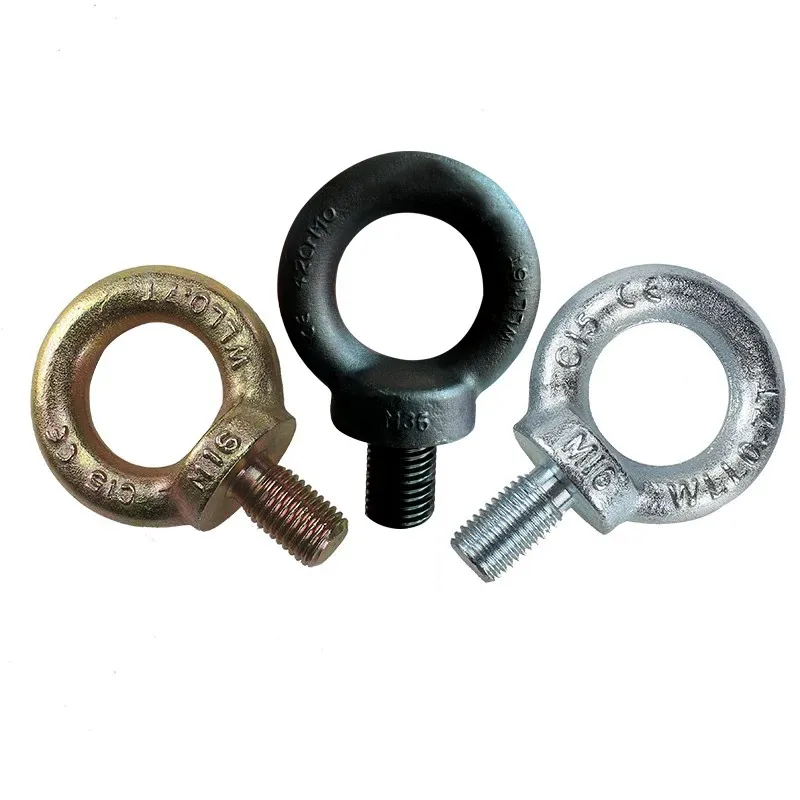
Where They’re Used
Machine shops lifting molds and dies, wind-turbine nacelle assembly, construction prefabs, oil & gas tool handling, and aerospace fixtures. Many customers say a rotating Hoist ring pays for itself the first time a load doesn’t spin and chew up threads—honestly, I’ve seen that too.
Vendor Snapshot (what buyers actually compare)
| Vendor | Lead Time | Certs | Customization | Notes |
|---|---|---|---|---|
| LZ Fasteners (Hebei) | 7–15 days (stock sizes) | ISO 9001, EN 1677 test reports | Threads, finish, laser ID, torque spec sheets | Strong on M6–M22; batch proof tests shared |
| Vendor A | 2–4 weeks | ASME marks, RFID option | Color coding, swivel bearings | Premium pricing |
| Vendor B | In-stock, limited sizes | Basic COC | Minimal | Economy line; verify WLL |
Customization and Real-World Feedback
- Custom threads (UNC/UNF), extended shanks for deep tapping, corrosion packs (HDG or Zn-Ni), and laser QR for traceability.- One mold shop told me their M16 Hoist ring with extended shank cut changeover time by ≈12% because techs stopped hunting for spacers. Small tweak, big gain.
Quick Use Notes
-
- Engage full thread depth; use torque listed for your Hoist ring and lubrication state.
- Align in load direction; derate for angles; never exceed WLL.
- Inspect before each lift; annual NDT for critical service is a good practice.
Test Data Snapshot
Recent batch (sample): M12 units proof-tested at 3.0 t (≈2.5× WLL 1.2 t); destructive break at ≈5.1× WLL; threads gauged to 6H; plating passed 72 h salt-spray. Not laboratory peer-reviewed, but consistent with EN 1677 practice.
Standards That Actually Matter
Specify conformance to ASME B30.26 rigging hardware, EN 1677 for lifting components, and follow OSHA 1910.184 use rules. For design-in, align with risk assessment per ISO 12100. It sounds dry—because it is—but it keeps people safe.
- ASME B30.26 – Rigging Hardware
- EN 1677 – Components for Chain Slings
- OSHA 29 CFR 1910.184 – Slings
- ISO 12100 – Safety of Machinery, Risk Assessment
Latest news
-
Reliable DIN 127 Spring Washers for Industrial Applications | LZ Fasteners
NewsDec.03,2025
-
Comprehensive Guide to DIN 126 Washer: Specifications, Uses & Benefits
NewsDec.03,2025
-
Durable and High-Quality Din 125a A2 Washers for Industry | LZ Fasteners
NewsDec.03,2025
-
Comprehensive Guide to DIN 125A Washers – Specifications, Applications & Vendors
NewsDec.03,2025
-
Din 125 Washer - Reliable Industrial Fastening Solutions from LZ Fasteners
NewsDec.03,2025
-
What is a DIN 125 Flat Washer? Global Significance, Specs & Vendors
NewsDec.03,2025
 English
  Afrikaans
  Arabic
  Bengali
  Bulgarian
  French
  German
  Hindi
Hindi  Indonesian
  Italian
  Japanese
  Korean
  Malay
Malay  Portuguese
  Russian
  Spanish
  Thai
Thai  Turkish
  Urdu
Urdu  Vietnamese